g550 | Private Jet Blog | Magellan Jets
Magellan Jets Blog

Sign up for updates from Magellan Jets!

Your email:

Get an instant charter quote

Empty Legs Available Now!

The #1 Private Jet Blog

Current Articles | RSS Feed RSS Feed

Pets and Private Jets; The New Way to Charter


pet blog resized 600

It's Wednesday, and there are only  two more days left until your heavily anticipated family getaway.  You’re finishing up your loose ends at work for the week and the only thing on your mind is laying on a beach and soaking up the sun.  Then it hits you…the beloved family dog, Max.  How could you forget?  Max is your daughter’s favorite companion and she would be devastated if he wasn't there for the family vacation.    

 While this story doesn’t pertain to everyone, traveling with pets has become more and more of a necessity in recent years.  Pet day cares cost a premium and leave many pet owners worrying about the safety of their given pet.  Were they let out this morning? Were they fed? Are they scared and alone?  For many animal lovers leaving their pet at home is simply not an option.  Additionally, flying your pet to your given destination brings up stressful concerns.  In 2009, there were over 30 instances of pets ending up lost, injured, or killed while being transported via airline.  What options are available to modern animal lovers? Enter, Magellan Jets.     

 Magellan Jets knows and understands the concerns of animal lovers out there.  We care about the safety and happiness of your pet(s) as well as your peace of mind.  We are strategically innovating the industry with our focus and expertise on pet travel.  Magellan works with you and a number of pet approved charter operators to assure you have the perfect aircraft for you and your pets.  Rest stops, toys for your pet, and a pet friendly crew are just a few of the ways Magellan Jets works for you to ensure your experience is a great one.  Contact Magellan Jets and discover a safer, smarter way to fly with your pet!


Gulfstream G550 Business Jet Sets New Speed Record


charter gulfstream g550

A Gulfstream G550 ultra-long range business jet has set yet another speed record. The jet is equipped with Rolls-Royce BR710 turbofan engines that help push the maximum range to 6,750nm at Mach 0.80, allowing the jet to fly non-stop from Tokyo to Paris.

This most recent record-setting flight took off from Savannah, GA’s Hilton Head International Airport and completed the 3,894nm flight to Campinas, Brazil in just 8 hours and 28 minutes. The luxury business jet averaged a cruising speed of 519mph over the ground.

The G550 represents the pinnacle of luxury travel offering seating for up to 18 passengers and a cabin with up to four living areas to make long flights more comfortable. Since its introduction in 2003, the G550 business jet has set more than 50 city-pair speed records.

Via Aviation Business

Tags: ,

Gulfstream GV, G500, and G550 - What's the Difference?


Have you ever wondered what the difference was between the Gulfstream GV, G500, and the Gulfstream G550 private jets? When looking to charter a jet, it is important to know the exact ins and outs of the aircraft that you are planning to fly on. Obviously, we make it a point to supply the best aircraft possible when you charter jets through Magellan Jets, but it’s still good to know all the facts!

When examining the interior of the Gulfstream GV, G500, and the G550 it is important to research and learn all about the amenities and cool gadgets on board. The G500 and G550 are both equipped with a PlaneView cockpit, which is currently the most advanced flight deck in business aviation. The systems in each aircraft are based on Honeywell’s next generation Primus Epic integrated avionics suite. The G500 and G550 are both equipped with Gulfstream’s signature Cursor Control Device (CCD). The CCD aids pilots in flight planning, navigation, and communications in flight by improving the way that pilots interact with the PlaneView avionics system. Although the GV does not offer CCD or PlaneView, there is a new option to install PlaneDeck which converts the displays from older tube-style displays to LCDs, and offers much of the same features. PlaneDeck is also Synthetic Vision System (SVS) capable. The optional Synthetic Vision Primary Flight Display (SV-PFD) adds to the enhanced situation awareness even in zero visibility conditions right on the main cockpit display (instead of a separate screen).

PlaneDeck and SVS

Gulfstream PlaneDeck featuring SVS and EVS

All three aircraft (GV, G500, & G550) have Enhanced Vision System (EVS). EVS significantly improves situational awareness by providing an infrared video feed of the environment and presenting the pilot with a clear view of runway markings, taxiways, and the surrounding landscape at night or in the worst weather conditions. Each aircraft is also equipped with autoland, a system that fully automates the landing phase of an aircraft’s flight, with the human crew supervising the process. Gulfstream has been able to manufacture each aircraft with the best Flight Management Systems, ensuring additional safety, comfort, and efficiency.

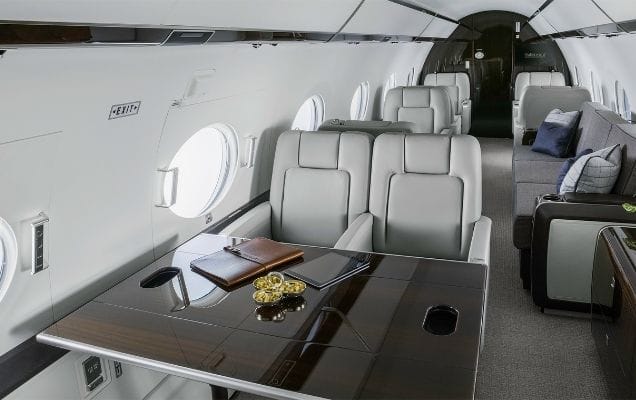
The cabins aboard each Gulfstream combine productivity with exceptional comfort. The signature oval windows provide ample sunlight and a continuous supply of 100 percent fresh air throughout the cabin keeps passengers comfortable on long flights. With options for four distinct living areas, three separate temperature zones and a choice of available configurations that seat up to 18 passengers, passengers are able to indulge in complete business luxury. Maintaining contact with the home or office is even easier with a host of standard communication features: a fax machine, a printer, a wireless local area network and satellite communications are all available as options. Cabins arranged as separate groupings encourage working, dining, entertaining or resting to help keep fresh and productive.

Gulfstream G550 Cabin

Gulfstream G550 Cabins

These aircraft are three of the most popular private jet charters and are well established in ultra-long range and large cabin category. The Gulfstream GV, G500, and G550 are three extraordinary airplanes that offer extensive range and impressive speeds without sacrificing cabin comfort. Gulfstream has been manufacturing airplanes for over 50 years and is used to setting the standard for business travel. They have a top-rated service center network that stands ready to provide assistance on six continents. If we were to recommend an aircraft for a long, luxurious business travel, you better bet it’s a Gulfstream GV, G500 or G550.

PerformanceGVG500G550
Max Range (Mach 0.80) 6,500 nm 5,800 nm 6,750 nm
Max Operating Speed Mach 0.885 Mach 0.885 Mach 0.885
Max Cruise 51,000 ft 51,000 ft 51,000 ft
Max Takeoff Weight 90,500 lbs 85,100 lbs 91,000 lbs

Design SpecificationsGVG500G550
Engines Rolls-Royce BR710A1-10 Rolls-Royce BR710C4-11 Rolls-Royce BR710C4-11
Rated Takeoff Thrust 14,750 lbs 15,385 lbs 15,385 lbs
Typical Seating 14-18 14-18 14-18
Length 96.42 ft 96.05 ft 96.05 ft
Height 25.83 ft 25.10 ft 25.10 ft
Wing Span 93.50 ft 93.06 ft 93.06 ft

5 Steps to Get a New Charter Jet in the Air


The FAA places very stringent safety measures on any new aircraft. A new type of jet (Gulfstream G550, Bombardier Global Express, Cessna Citation X, etc) must meet many requirements for test flights and performance under extreme conditions. Not anyone can build a plane and have it certified to carry paying passengers! There are many safety steps that have to be taken when a new jet is being tested, but here are some of the biggest (and most interesting!)

Get a Design Approved

Private Jet DesignsPhoto credit Flickr user margaretshear.

Before you even start building new aircraft manufacturers like Boeing or Cessna have to ensure that they can meet the FAA’s standards for the process of actually building the new aircraft. The FAA likes to see that you have the proper equipment in place and the right training and safety procedures to keep errors from happening when new jets are being built. If you’re using new fabrication methods (a new type of welding or creating a new composite material) then those methods have to be tested by themselves before you can use them for a new aircraft!

Perform Ground Tests

Private Jet Ground Tests width=Photo credit Flickr user Global Jet.

Before the new aircraft leaves the ground for the first time it has already been heavily tested. Test pilots spend a lot of time taxiing the jet at low and high speeds checking for stability, controllability, and handling characteristics. They'll test the engines by throttling them up to full and then pulling them back quickly to make sure they won't quit. They also make many mock-takeoffs—accelerating to takeoff speed and then stopping as quickly as possible to test the brakes and see how quickly the new jet can come to a stop.

Complete Flight Tests

Once you build your first test aircraft—and often it takes many years and many millions of dollars to do so—you begin a rigorous series of test flights to examine every aspect of the new jet’s characteristics. This gives the manufacturer a chance to figure out all the data that goes into the aircraft’s flight manual. Pilots refer to these flight manuals every time they fly to perform the calculations necessary to go safely and efficiently. Many aircraft have well over 1000 hours of flight test time before they’re certified to carry passengers!

Perform Systems Tests

Private Jet System Tests width=Photo credit Flickr user DieselDemon.

When you’re cruising comfortably at 45,000 feet, you want to know that the jet you’re on is going to stay comfortable! Test pilots take new jets up to high altitudes to run the systems through a gauntlet of challenging conditions. They make sure the cabin will stay pressurized (very important since the air at 45,000 feet is more than 5 times thinner than the air at sea level) and at a comfortable temperature. They also make sure things like the lights, the flat screens, the window shades, and the sound system all function the way they should. During this phase the pilots also check all their systems like autopilots, flight instruments, and de-icing equipment.

Pass Safety Tests

We’ve all heard that airplanes are the safest way to travel, but have you ever wondered why? After all when you’re flying on a private jet you’re travelling in a metal tube 8 or 9 miles above the ground at close to the speed of sound! The secret is the tough safety testing done on any new aircraft coming into the market. Test pilots check everything from stall speeds (when the aircraft is going too slow for the wing to produce lift) to performance during engine failures to how to fly the aircraft if all the electrical systems stop working. During this phase of the test process they develop procedures for every kind of emergency so that future pilots don’t have to come up with solutions in a real emergency! The procedures they develop maximize safety even in hazardous conditions and every pilot trained on that aircraft learns these procedures by heart!


This is just a snapshot of everything involved in taking a new jet from concept to design to product. The process, which has been developed since the airmail pilots started flying for hire in the 1920s, is centered on the idea that safety and reliability can be achieved in the inherently risky world of aviation. Add on the crew training and safety inspections, along with reliable third parties like ARG/US and Wyvern, and you can be confident that your next charter flight will be safe, efficient, and comfortable!

Chris Patten is an FAA licensed commercial pilot and a Flight Support Specialist for Magellan Jets.

Peter Jackson's $68 Million Gulfstream G550


g resized 600

Director Peter Jackson recently acquired a new Gulfstream G550 for an estimated price of $68 million. The private jet is one of the nicest jets on the market and can fly from New Zealand to Los Angeles non-stop. Jackson previously had a Gulfstream IV but was plagued with too many fuel stops, so he decided to trade up. The G550 can accommodate up to 16 passengers. Some of the seats can even be converted to beds, although those may require some pajamas. Jackson is a vintage aircraft collector and owns 29 World War I aircraft, some original and some replicas. Although we don’t charter vintage planes, Magellan Jets does have the capability of accommodating customers who would like large Gulfstream jets just like Mr. Jackson’s, all with the highest levels of safety and comfort and for far less cost than owning your own. Check out the link here

All Posts

By reading the Magellan Jets blog you agree to applicable terms of service